
Research grounded in real lives.
I use quantitative and qualitative methods to study economic security, inequality, identity, public attitudes, and collective well-being. I also develop assessments and learning tools that help organizations understand their own work.
Applied Research
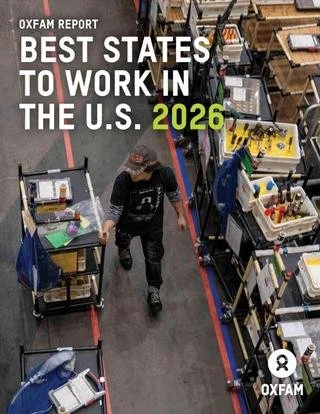
Best States to Work in the U.S. 2026
Co-author · Oxfam America · September 2026
I co-authored Oxfam America’s 2026 Best States to Work report, examining 37 labor policies across all 50 states, Washington, DC, and Puerto Rico. The index covers wages, worker protections, and rights to organize and collectively bargain.
This work brings together policy research and analysis of the conditions shaping workers’ economic security.
Related Press

CNBC Make It
These are the top 10 U.S. states for workers’ rights, says new report—8 of them have a minimum wage over $15
https://www.cnbc.com/2026/09/09/the-top-us-states-for-workers-in-2026-according-to-oxfam-report.html
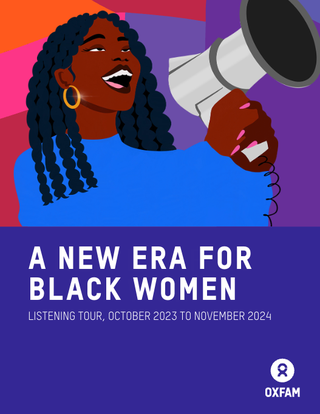
A New Era for Black Women: Listening Tour
Lead Researcher · Oxfam America · May 2025
I led qualitative research involving 190 participants across four Southern states for A New Era for Black Women. My work included thematic analysis and translating the listening-tour material into findings, recommendations, and public-facing research.
The project also carried into public conversation, including my participation in the Voices on the Ground webinar in June 2025.
Academic Publications
We the People: Public Advocacy for Public Policy
Co-author · Journal of Public Policy & Marketing · September 2026
In this research, the authors sought out and partnered with experienced experts and organizational leaders doing public advocacy work across a variety of functional areas (e.g., grassroots organizing, social movements, lobbying, media interventions to shift cultural norms) and diverse topics (e.g., hunger, economic justice, pay equity, workers’ rights, voting rights). The authors build on insights drawn from these partners’ experiences and from academic research related to advocacy to innovate a conceptual framework for public advocacy. They call on researchers to investigate and advance knowledge about public advocacy and its impact on public policy, individual and community well-being, and transformative social change.
Read the article: https://doi.org/10.1177/07439156261436038
Who Is Your Fate Linked To? Racial Discrimination Predicting Linked Fate Among People With Mixed-Race Ancestry
Vanessa Gonlin and Camryn Cobb · Social Identities · August 2023
People with mixed-race ancestry may experience connection with multiple ethnoracial groups, and ethnoracial discrimination may be associated with which ethnoracial groups individuals believe their fate is linked to. Using The Mixed-Race Ancestry Survey (2019), we examine the connection between people's reports of personal and group-level discrimination and their linked fate (believing what happens to a certain ethnoracial group impacts them) with various ethnoracial groups. Findings reveal that as personally experiencing ethnoracial discrimination increases, linked fate with all ethnoracial minorities increases. Thus, discrimination is strongly associated not only with linked fate with one's own ethnoracial minority group, but also the fate of other racialized minorities in the U.S. In addition, believing an ethnoracial group is discriminated against increases linked fate with said group in almost every case – including perceiving discrimination against Whites being associated with increased linked fate with Whites. Understanding the relationships between personal and group-level ethnoracial discrimination and linked fate strengthens our ability to predict outcomes and plan for the future.
Read the article: https://doi.org/10.1080/13504630.2023.2249406
Evaluation & Learning
Alongside public research, I develop assessments and tools for organizational learning. Selected work includes a baseline racial justice evaluation and an anti-racism learning dashboard.
Because this work can involve confidential organizational information, public examples are limited to materials approved for sharing.
Funded Research & Design
Zero Waste Spring Design Challenge
Principal Investigator, University of Georgia Office of Sustainability, January–May 2023. Total project award: $5,000.
Increasing ACE Protective Factors through Expanded Utilization of the EITC among Minority Households
Design Sprint Facilitator, HHS-funded project, September 2020–September 2023. Principal Investigator: Lance Palmer. Total project award: $1,346,697.
Collegiate Financial Education
Research Project Manager, AccessLex Institute-funded project, February 2020–February 2022. Principal Investigators: Dee Warmath and Brenda Cude. Total project award: $125,000.